The Palio di Siena: More Than a Race – Siena is a unique city in Italy, full of truly distinctive characteristics. It’s a relatively small city with a grand past.
While you can read and hear a lot about Siena’s history and art, the truth is, Siena’s true peculiarity lies in something much harder to define—its character, its spirit, and its deeply rooted mentality.
In my opinion, Siena is not a city to be explained, but rather one to be experienced.
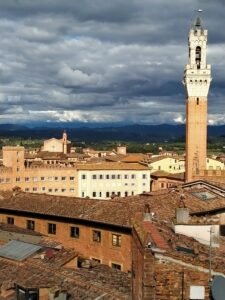
I was born and raised in Siena, in a family with deep roots in the city. I left at a young age to live abroad, but when I returned years later, I was struck by how little the city had changed.
That, in itself, is one of Siena’s defining traits: its extraordinary ability to preserve its traditions and identity, almost untouched by time.
Siena is a city of rare, unspoiled beauty. It hasn’t been overwhelmed by mass tourism, unlike its more famous rival, Florence.
It’s not the easiest place to reach—there are few direct trains, and no airport (the nearest one is in Florence).
Yet, despite this, Siena has long been one of Italy’s wealthiest cities, offering an enviable quality of life.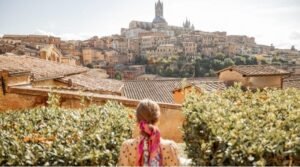
Siena doesn’t promote itself loudly. It’s almost as if the city chooses to remain hidden—intentionally, not out of necessity.
Centers of Excellence
Most people don’t realize that Siena is home to some true Italian cultural treasures.
For example, the Accademia Musicale Chigiana is world-renowned among musicians. Siena also hosts Italy’s first Jazz School, attracting top talent.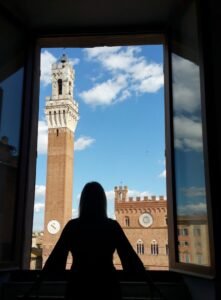
You’ll also find stunning art museums and the Santa Maria della Scala, a historic complex that was once Europe’s largest hospital.
Originally founded to serve pilgrims on the Via Francigena—the medieval route from Canterbury to Jerusalem—it now stands as a symbol of hospitality and care.
The Sienese School of Painting played a crucial role in the early development of the Renaissance, making Siena a recognized center of artistic excellence worldwide.
The Palio di Siena
Today, Siena is best known for its most iconic—and controversial—event: the Palio, a centuries-old bareback horse race that takes place twice a year in Piazza del Campo.
Animal rights activists often criticize the Palio as cruel, but these criticisms usually come from a lack of understanding of the event’s history and significance.
In Siena, the horse is sacred. It’s the hero—not the victim. Of course, accidents can happen, but the organization makes continuous efforts to ensure safety, including updated rules and strict veterinary oversight.
In fact, Siena is home to one of the few specialized horse rehabilitation clinics in Europe.
What Does “Palio” Mean?
The word Palio comes from the Latin “pallium”, a silk banner awarded to the winning Contrada.
So, “Palio” refers to both the race itself and the prize—a beautifully painted banner created by renowned artists.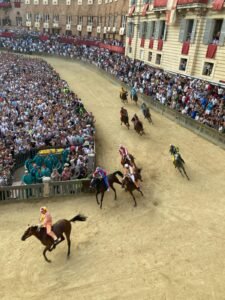
Horses race bareback around the square, driven forward by the passion of the Contrade.
Visitors may leave Siena with the impression that the Palio is simply an exciting game for contrada members. But the contrada carries great emotional and symbolic significance beyond the Palio, structuring social interactions in the city throughout the year.
Brief History
The Palio di Siena origins date back to the Middle Ages, and it was linked to the celebrations for the Assumption of the Virgin Mary, the city’s patron saint, on August 16th. This is the oldest Palio.
The Palio takes place also on July 2nd, this is dedicated to the Madonna of Provenzano and this started around 1600.
For long time the horse races took place along the narrow streets of Siena. It was called PALIO ALLA LUNGA.
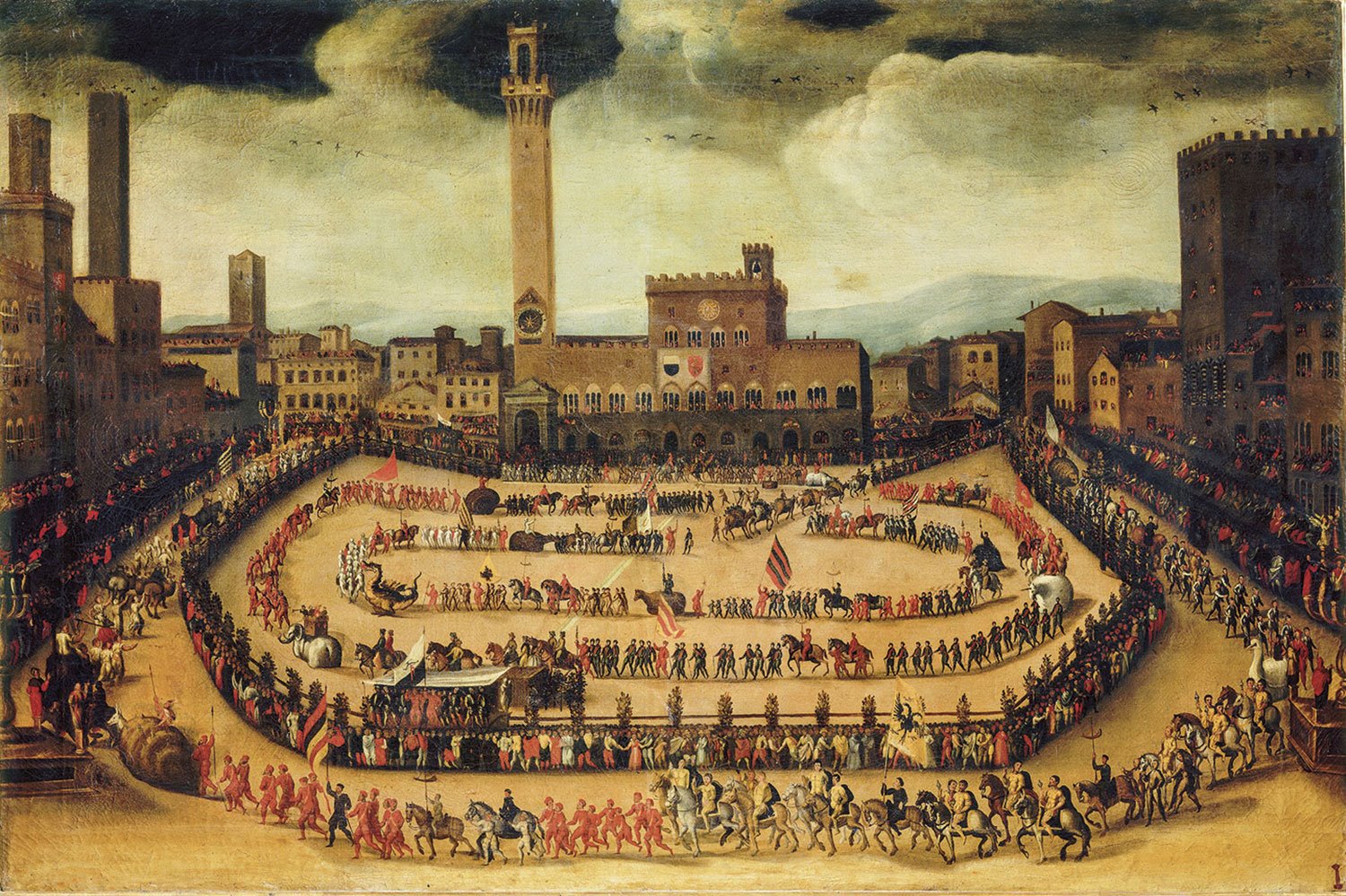
Starting from 1600 , the Palio was run “in tondo”, alla round the Piazza del Campo. This was called PALIO ALLA TONDA.
What the Palio Is Not
To understand the Palio, it’s better to start with what it is not:
- It is not a tourist attraction.
- It is not a historical reenactment.
- It is not a sporting event.
For the people of Siena, the Palio is a way of life. It’s part of the city’s identity—so deeply ingrained that even Oxford University has studied it.
Oxford University Study
A PhD thesis conducted at Oxford*examined the social dynamics of the Palio.
It explored how past and present relationships within the Contrade—the city’s neighborhood communities—interweave to form an intricate social web.
The findings show how what seems to be a local event actually reflects broader patterns of human behavior: cooperation, conflict, loyalty, and community. The Palio isn’t just a race—it’s a mirror of society.
The Soul of Siena
Siena has about 55,000 inhabitants, and the historic center is divided into 17 Contrade.
Each Contrada is like a small city within the city—complete with its own church, fountain, museum (where Palio victories are saved), and social club, known as the Società.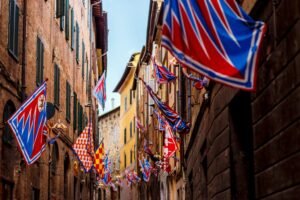
The Contrada system evolved from military organization in the Middle Ages. Siena was once one of the most powerful and populated cities in Italy, constantly under threat from rival cities like Florence.
The Contrade were well-trained, well-organized units meant to defend the city. Even today, each Contrada retains military-inspired roles and rituals. For example, each Contrada has a “Capitano”, or captain.
This historical legacy is part of what creates the intense, almost war-like atmosphere during the Palio parade before the race.
Interestingly, three areas in the city center belong to no Contrada: the Cathedral, Piazza del Campo, and the Medici Fortress.
Growing Up in a Contrada
Belonging to a Contrada is determined by birth or family tradition. Many people choose to formalize their membership through a non-religious baptism, which can happen at any age.

Contrada members (or contradaioli) often form strong bonds with each other—even forming alliances or rivalries with other Contrade.
These rivalries run deep: it’s not unusual for locals to avoid buying a house in the territory of a rival Contrada! Children grow up immersed in Contrada life, learning from an early age to ask:
“What’s your name? Which Contrada are you from?”
The Impact of Contrada Life
The Contrada system has a profound impact on Siena’s social life. It creates a strong sense of identity and belonging, but also comes with its pros and cons.
On the positive side:
- Contrade offer community support for people of all ages.
- Older people stay socially active within their Contrada and often don’t need to move to retirement homes.
- There’s a strong intergenerational bond: children learn to respect elders, and elders feel valued for their wisdom.
- A kind of neighborhood watch effect helps prevent crime, drug use, and bullying.
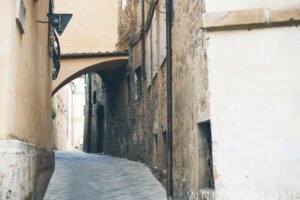
Siena-by-VINITA -Salomè
But there are downsides:
- Life within a Contrada can be insular.
Many Sienese are so deeply rooted in their local life that they show little interest in the world outside Siena. - It can lead to a kind of cultural stagnation.
Change is often resisted, and young people may find it difficult to move away (they really don’t want to) even for job opportunities.
Siena-by-VSalomè
As with all things, there is both light and shadow. But there is no doubt: the Palio and the Contrade make Siena an extraordinary city—one that must be lived to be truly understood. Experienced not explained.
*The palio of Siena and the contemporary contrada system. Adam R. Kenny and Laura Fortunato /Institute of Human Sciences , University of Oxford – Calleva Research Centre for Evolution and Human Sciences,Magdalen College, Oxford – Santa Fe Institute